



Managing a poker bankroll in cryptocurrency introduces a layer of complexity that fiat bankroll management does not address: the underlying asset fluctuates in value independently of your poker results. A player who runs well at the tables can still see their bankroll decline in dollar terms due to market movement, while a losing session can appear neutral if the asset appreciates. Standard bankroll management rules—buy-in thresholds, stop-loss limits, shot-taking criteria—must be recalibrated to account for this volatility dimension.
The core challenge is that crypto poker bankrolls exist in two simultaneous frames: units of account (the cryptocurrency itself) and purchasing power (fiat equivalent). Professional players must decide which frame governs their decision-making, because the answer determines how they size buy-ins, set stop-loss thresholds, and manage storage between sessions.
This guide covers the operational mechanics of crypto bankroll management—how to account for volatility, structure hot and cold storage allocation, use stablecoins as a risk management tool, and apply security protocols that protect funds without creating access friction during active play.
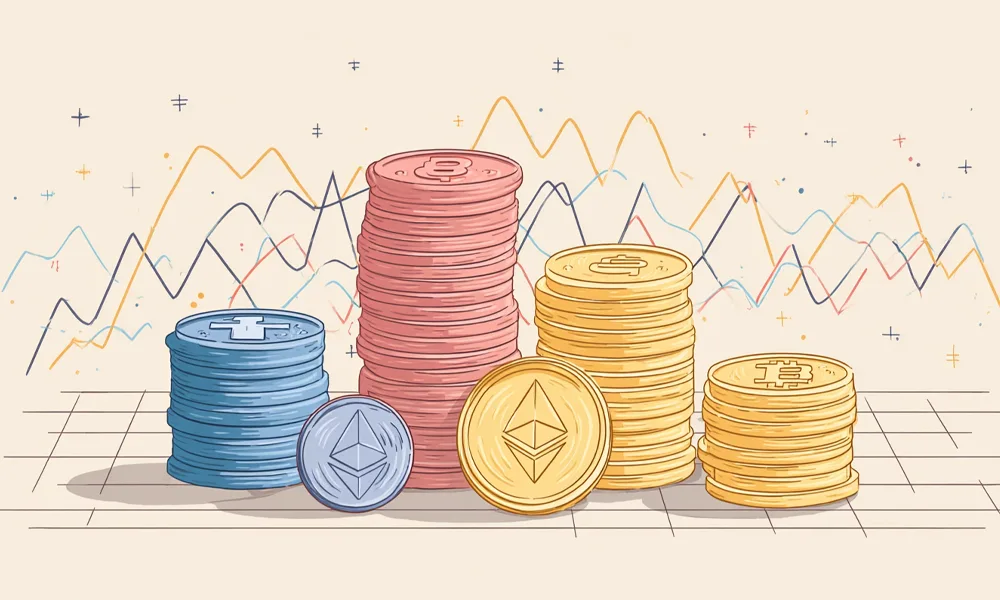
The Volatility Problem in Crypto Bankroll Management
Traditional bankroll management assumes a stable unit of account. When you hold 50 buy-ins in fiat, the number means what it says. In crypto, holding 50 buy-ins denominated in Bitcoin creates a moving target: a 20% BTC price decline reduces your effective bankroll to 40 buy-ins overnight, with no poker variance involved.
This creates two distinct risk sources that operate independently: poker variance (win/loss results at the table) and market variance (asset price movement). Managing only one while ignoring the other is incomplete risk management. Players who denominate their entire bankroll in volatile crypto are taking on market exposure they may not have consciously chosen.
The volatility problem does not have a single correct solution. It has trade-offs. Denominating in crypto means exposure to price gains as well as losses. Converting entirely to stablecoins eliminates market risk but removes upside participation. The operationally sound approach is to make an explicit allocation decision based on your risk tolerance and time horizon—rather than defaulting to whatever the site holds.
Denominating Buy-Ins: Crypto Units vs. Fiat Equivalent
Players typically use one of two approaches. The first is crypto-native denomination: buy-ins are sized in BTC, ETH, or another asset, and bankroll sufficiency is measured in coin units. This approach exposes the bankroll to full market variance but preserves the simplicity of not converting. The second is fiat-equivalent denomination: buy-ins are sized based on current market value, and bankroll thresholds are maintained in dollar or euro terms. This approach requires more active tracking but produces clearer risk parameters.
Neither method is universally correct. Players in jurisdictions where crypto gains are taxable events may prefer to minimize conversions, favoring crypto-native denomination. Players whose living expenses are in fiat may prefer fiat-equivalent denomination to maintain clearer real-world purchasing power awareness. The critical point is that the method must be chosen deliberately, not by default.

Hot and Cold Storage Allocation for Active Players
Active poker players face a specific storage challenge: they need funds accessible enough for session deposits while keeping the majority of their bankroll in secure storage. The hot/cold split is the standard solution, but the correct split ratio depends on session frequency, deposit lead time, and the player’s risk tolerance for online exposure.
Hot wallets—software wallets, exchange accounts, or funds held directly on the poker site—provide immediate access but carry higher risk exposure. Software wallets on internet-connected devices are vulnerable to malware. Exchange wallets carry platform risk (hacks, insolvency, regulatory freezes). Site balances carry counterparty risk specific to the operator. Any funds in hot storage should be treated as operationally necessary exposure, not a security-neutral choice.
Cold storage—hardware wallets with offline key management—eliminates remote attack vectors but introduces access delay. Moving funds from a hardware wallet to a poker site involves an on-chain transaction with confirmation requirements ranging from minutes (Litecoin, Ethereum) to 30+ minutes (Bitcoin under normal conditions). Players who need to deposit quickly cannot always wait for cold storage retrieval cycles.
Recommended Allocation Framework
The appropriate hot/cold split depends on session cadence. Players who play daily may keep a larger hot wallet balance to avoid repeated on-chain transactions and their associated fees. Players who play weekly or less frequently can afford to keep a smaller hot allocation and refill from cold storage between sessions. A common operational approach is to maintain enough in hot storage to cover 5–10 buy-ins at your primary stake level, with the remainder in cold storage, and to schedule refill transfers during low-fee network windows to minimize costs.
Hardware wallets typically become operationally justified when holdings exceed 5–10x your normal session buy-in, based on risk tolerance and technical comfort. Below that threshold, the security premium of a hardware wallet may not justify the operational overhead. Above it, single-key compromise on a hot wallet represents meaningful loss relative to total bankroll—making offline key storage the rational choice.

Using Stablecoins as a Bankroll Risk Management Tool
Stablecoins—USDT, USDC, and similar assets pegged to fiat currencies—provide a mechanism to hold value on-chain without exposure to crypto market volatility. For bankroll management, they function as a conversion layer between crypto infrastructure (fast transactions, pseudonymous processing, no banking intermediaries) and fiat stability (predictable purchasing power).
The trade-off with stablecoins is that they eliminate market risk while introducing different risks: smart contract risk (the code governing the token can have vulnerabilities), centralized reserve risk (USDT and USDC are backed by reserves controlled by Tether and Circle respectively), and regulatory risk (stablecoin issuers can freeze addresses under legal compulsion). These risks are generally lower than volatile asset price risk for bankroll management purposes, but they are not zero.
Practical Stablecoin Allocation Strategy
A practical approach used by professional players is to maintain a portion of the total bankroll in stablecoins as a floor—the amount required to sustain their current stake level regardless of market conditions. Volatile crypto holdings (BTC, ETH) represent upside participation above that floor. If volatile assets appreciate, the player benefits. If they decline, the stablecoin floor ensures the bankroll remains functional.
The specific split between stablecoins and volatile crypto depends on the player’s market outlook, tax situation, and psychological tolerance for portfolio swings. There is no universally correct ratio. The principle is that the split should be a deliberate decision, not an accidental result of whatever happened to be in the wallet at deposit time.
Operational Scenario: Managing a Bankroll Through a Volatility Event
Player maintains a bankroll across three layers: funds on the poker site, a hot software wallet, and cold hardware wallet storage. The asset allocation is approximately 60% volatile crypto (BTC and ETH) and 40% stablecoin (USDC). A significant market correction occurs: BTC declines 35% and ETH declines 40% over a 72-hour period.
- Site balance (denominated in BTC): effective fiat value drops ~35%, reducing buy-in count at that stake level
- Hot wallet (mixed BTC/USDC): partial loss on BTC portion, USDC portion unaffected
- Cold storage (BTC/ETH): largest nominal loss in fiat terms, but unchanged in coin units
- Total effective fiat bankroll: declines approximately 21% due to the 40% stablecoin buffer
The Decision Point
The player must now decide whether to move down in stakes to restore the original buy-in count relative to effective bankroll, continue at the same stake level accepting the reduced margin, or convert additional volatile crypto to stablecoins to stabilize the remaining balance. The correct answer depends on whether the player denominates in crypto units or fiat equivalent—and this is why that decision must be made before volatility events occur, not during them. Reactive decisions made during drawdowns combine poker variance stress with market stress, producing worse outcomes on both dimensions.
The Outcome
The stablecoin allocation absorbed approximately 40% of the market shock. The player’s poker-funded sessions remained viable without requiring immediate action. Had the full bankroll been in volatile crypto, the effective fiat drawdown would have been 35–40%, likely triggering forced stake reduction during a period of elevated psychological stress—when decision quality is typically lowest.
How Professional Players Structure Crypto Bankroll Operations
Experienced crypto poker players treat bankroll management as a system with defined rules that operate independently of in-session emotional state. The key structural elements are pre-defined allocation ratios, scheduled refill windows, and clear stake-sizing rules that account for volatility.
Technical Risk Management
Professionals set buy-in thresholds relative to their stablecoin floor rather than total crypto holdings. This prevents a scenario where a bull market inflates the apparent bankroll—encouraging stake increases—followed by a correction that drops effective bankroll below the minimum for the new stake level. The stablecoin floor represents the real bankroll for stake-sizing purposes; volatile holdings represent potential upside, not guaranteed capital.
System Optimization
Advanced players minimize on-chain transaction costs by batching cold-to-hot transfers during low-fee network periods, typically weekends or early UTC morning hours when mempool congestion is lower. They use SegWit addresses for BTC transactions (30–40% fee reduction) and USDC on efficient networks for stablecoin transfers where the poker site supports multiple chains. The ACR Poker software supports multiple cryptocurrency deposit options, allowing players to select the network and asset that optimizes for current fee conditions rather than defaulting to a single option. Minimizing fee drag across frequent deposits compounds meaningfully over high-volume play.
Technical Evolution in Crypto Bankroll Infrastructure
Current bankroll management complexity is partly a function of on-chain settlement limitations—confirmation delays, fee variability, and the friction of moving funds between cold storage and active play. Layer 2 protocols (Lightning Network for Bitcoin, various rollup solutions for Ethereum) are progressively reducing this friction by enabling near-instant settlement at minimal cost without requiring funds to remain in hot storage continuously.
As poker sites integrate Layer 2 deposit and withdrawal infrastructure, the hot/cold split will require less manual management. Players will be able to maintain cold storage security while accessing funds at Layer 2 speed, eliminating the current trade-off between security and accessibility. This does not eliminate the volatility management challenge—stablecoin allocation strategy and denomination decisions will remain relevant—but it reduces the operational overhead of moving funds efficiently.
Players who develop clear allocation frameworks and storage protocols now will be positioned to adapt as infrastructure improves. The underlying principles—explicit denomination decisions, defined stablecoin floors, and security-aware storage architecture—remain valid regardless of settlement layer evolution.
Frequently Asked Questions
Should I denominate my poker bankroll in crypto units or fiat equivalent?
There is no universally correct answer. Crypto-native denomination is simpler and avoids taxable conversion events in many jurisdictions. Fiat-equivalent denomination provides clearer real-world purchasing power awareness. The critical point is making an explicit choice before variance events occur—not defaulting to whichever frame feels convenient in the moment. Mixed approaches (stablecoin floor + volatile upside) are used by most professional players.
What percentage of a crypto poker bankroll should be kept in stablecoins?
The stablecoin percentage should cover at least the minimum buy-in count required to sustain your current stake level under your chosen bankroll management rules. Beyond that floor, the split between stablecoins and volatile assets depends on market outlook, tax situation, and volatility tolerance. There is no fixed correct ratio—the allocation must be a deliberate decision, not an accidental result of deposit timing.
Are stablecoins risk-free for bankroll storage?
No. Stablecoins eliminate volatile asset price risk but introduce smart contract risk, centralized reserve risk, and regulatory risk. USDT and USDC are backed by reserves controlled by their respective issuers, who can freeze addresses under legal compulsion. These risks are generally lower than market volatility risk for bankroll management purposes, but they are not zero and should be understood before allocation decisions are made.
How does a crypto market downturn affect bankroll management decisions?
A market correction reduces effective fiat bankroll independently of poker results, potentially dropping the bankroll below minimum buy-in thresholds for the current stake level. Players denominating in crypto units may not notice the impact; those using fiat-equivalent denomination must decide whether to move down in stakes, maintain current stakes at reduced margin, or convert volatile holdings to stablecoins. This decision should be governed by pre-defined rules, not reactive judgment during a drawdown.
When does a hardware wallet become necessary for bankroll security?
Hardware wallets typically become operationally justified when holdings exceed 5–10x your normal session buy-in, based on individual risk tolerance and technical comfort level. Below that threshold, the security premium may not justify the operational overhead of offline key management. Above it, a single compromise of a hot wallet key represents a meaningful loss relative to total bankroll, making offline key storage the rational choice.
How should players minimize transaction fees across frequent deposits?
Batch cold-to-hot transfers during low-fee network windows—typically weekends or early UTC morning hours. Use SegWit addresses for Bitcoin transactions (30–40% fee reduction versus legacy formats). For stablecoin transfers, select the most cost-efficient network the poker site supports (Tron-based USDT is typically cheaper than Ethereum-based USDT). Monitor real-time fee conditions via mempool.space before initiating transfers. Fee savings compound meaningfully over high-volume play.