



Crypto poker bankroll management introduces a challenge absent in fiat bankroll strategy: cryptocurrency price volatility creates secondary variance independent of poker results. A 30% Bitcoin drawdown during a month of break-even poker produces a 30% bankroll reduction despite neutral playing performance. This volatility exposure requires allocation strategies that traditional bankroll management doesn’t address.
The core problem is that cryptocurrency serves dual roles—it’s both your poker bankroll and a volatile asset position. Standard poker bankroll rules (holding 20-30 buy-ins for your stake) don’t account for the asset itself losing 15-25% value in a single week. Professional crypto poker players manage this through structured allocation between hot storage (immediate play access), cold storage (security priority), and stable assets (volatility hedge).
This guide explains how cryptocurrency volatility impacts poker bankroll stability, breaks down professional allocation protocols, and outlines the rebalancing strategies experienced players use to maintain consistent playing capital despite market fluctuations.
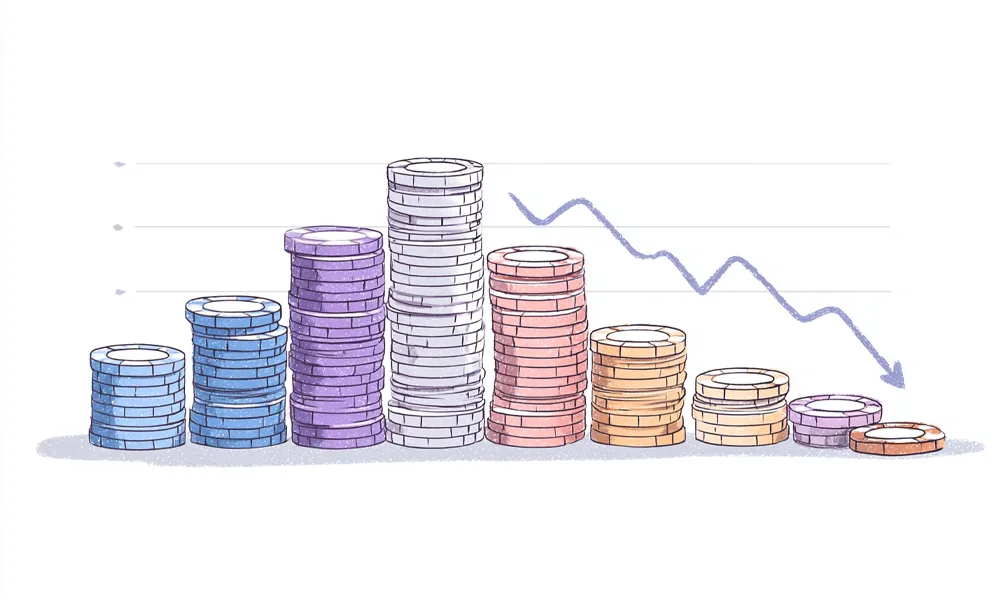
How Cryptocurrency Volatility Affects Poker Bankroll
Traditional poker bankroll management calculates risk of ruin based solely on win rate variance and stake level. With cryptocurrency, you face compound variance: poker variance plus price volatility. A player with 25 buy-ins in BTC experiences adequate cushion against poker downswings but remains exposed to 40-60% annual Bitcoin price swings that can eliminate entire bankroll buffers.
Price volatility manifests in two dimensions: absolute volatility (how much prices move) and correlation timing (when moves occur relative to your play schedule). Bitcoin’s 60-day realized volatility typically ranges from 40-80% annualized. This means a $10,000 BTC bankroll can reasonably fluctuate between $8,000-$12,000 over two months purely from price action, independent of poker results.
The compounding effect creates asymmetric risk. A 30% price drop requires a 43% price recovery to restore original value (e.g., $10,000 → $7,000 → $10,000). During the recovery period, your effective buy-in count decreases, forcing stake adjustments or increased bust-out risk. If you’re rolled for $2/$5 with 25 buy-ins ($12,500 in BTC) and BTC drops 35%, you now hold 16 buy-ins—requiring a move down to $1/$2 despite unchanged poker performance.
Volatility also affects psychological capital and decision quality. Watching your bankroll decline 20% from price movement during a poker downswing creates compounded stress that degrades play quality. Separating price volatility from poker variance becomes critical for maintaining proper decision-making under compound pressure.

What This Means for Your Allocation Strategy
Managing crypto bankroll volatility requires explicit allocation decisions traditional poker bankroll management doesn’t demand. You must determine what percentage stays in volatile cryptocurrencies versus stable assets, how much remains in hot storage versus cold storage, and when to rebalance between allocations as prices move.
The fundamental allocation framework divides bankroll into three segments: hot wallet (immediate play access, 10-20% of total), cold storage (security priority, 50-70% of total), and stable assets (volatility hedge, 20-30% of total). Each segment serves distinct purposes with different risk-return profiles. Hot wallets prioritize liquidity over security and accept full volatility exposure. Cold storage prioritizes security over accessibility and may include more volatile high-appreciation assets. Stable allocations sacrifice appreciation potential for predictable value.
Allocation percentages depend on volatility tolerance and playing frequency. High-volume players need larger hot wallet allocations (15-20%) to avoid frequent cold-to-hot transfers that create operational overhead and security exposure. Recreational players can maintain minimal hot allocation (5-10%) since they rarely need immediate large deposits. Players with low volatility tolerance should increase stable allocation (30-40%) even though this reduces appreciation upside.
Common Mistakes Players Make
- Keeping entire bankroll in one volatile cryptocurrency (BTC or ETH) without stable allocation, experiencing 40%+ drawdowns from price action alone during normal market volatility
- Maintaining inadequate buy-in cushion relative to volatility—holding 20 buy-ins in crypto that should require 30+ buy-ins to account for price swings
- Treating crypto price gains as bankroll growth and moving up stakes, only to discover the move-up coincided with price peak before a 50% correction
- Never rebalancing allocation as prices move, allowing 20% stable allocation to drift to 5% during crypto bull run, then experiencing full downside exposure during correction

Hot vs Cold Storage Allocation
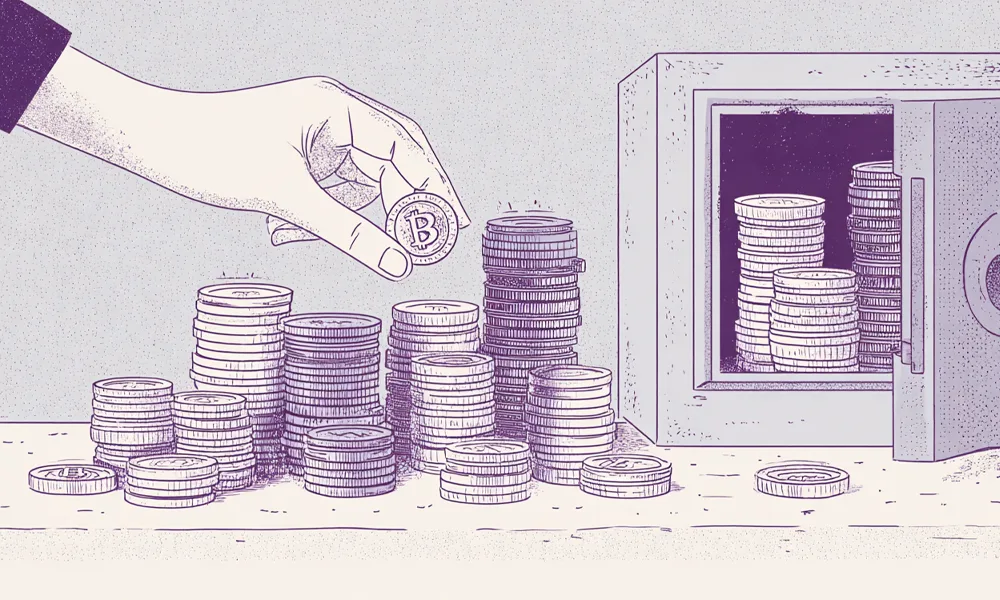
Hot storage (exchange accounts, software wallets with site access) and cold storage (hardware wallets, paper wallets) serve different operational functions. Hot storage enables immediate deposits without transfer delays or hardware wallet access. Cold storage protects majority bankroll from exchange hacks, account seizures, and operational mistakes. The allocation between them involves security-liquidity tradeoff.
Professional allocation targets 10-20% hot, 80-90% cold for most players. This provides 5-10 immediate buy-ins in hot storage while protecting majority bankroll in cold storage. High-volume players may increase to 20-25% hot to reduce transfer frequency. The key metric: hot allocation should cover 2-3 weeks of expected play volume without requiring cold storage access.
Transfer logistics matter. Cold-to-hot transfers require hardware wallet access and typically 20-60 minutes for transaction confirmation. Players should schedule transfers during non-play periods, maintaining hot wallet buffers that prevent emergency mid-session transfers. Running hot storage to zero during active play creates forced breaks or risky rushed transfers.
Stable Asset Allocation for Volatility Protection
Stablecoins (USDT, USDC, DAI) provide fiat-equivalent value within crypto infrastructure. Allocating 20-30% of bankroll to stablecoins creates a volatility buffer that preserves buying power during crypto price declines. When BTC drops 30%, your stable allocation maintains full value, reducing total bankroll impact to 21% (70% × 30% decline).
The stable allocation serves as rebalancing reserves. During crypto price declines, you can convert stable holdings to crypto at lower prices, maintaining constant buy-in count. During crypto appreciation, you can convert gains to stables, locking in profits and rebuilding volatility buffers. This counter-cyclical approach reduces drawdown severity and captures appreciation upside.
Stablecoin selection introduces counterparty risk. USDT and USDC depend on centralized reserves that create trust requirements. DAI uses decentralized collateral but introduces smart contract risk. Professional players diversify stable allocation across 2-3 stablecoins to reduce single-point failure risk, typically 50% USDC, 30% USDT, 20% DAI for balanced exposure.

Professional Bankroll Allocation Under Volatility
A player maintains a $50,000 crypto poker bankroll playing $5/$10 NLHE (requiring 20 buy-ins minimum, 30 buy-ins for conservative management). Current allocation target: 15% hot, 60% cold, 25% stable.
- Hot storage: $7,500 (7.5 buy-ins in BTC for immediate access)
- Cold storage: $30,000 (split 50% BTC, 50% ETH for diversification)
- Stable allocation: $12,500 (USDC for volatility protection)
- Total buy-ins: 50 (well above 30 buy-in requirement)
- Volatility buffer: 25% stable provides 40% downside protection before requiring stake adjustment
The Technical Process
Bitcoin drops 35% over 30 days during a market correction. The player’s allocation shifts due to price action: BTC value: $22,750 (was $35,000), ETH value: $10,500 (was $15,000, 30% decline), stable value: $12,500 (unchanged), total bankroll: $45,750 (down 8.5% vs 35% BTC decline).
The stable allocation reduced total drawdown from 35% to 8.5%—preserving 45.75 buy-ins despite severe crypto decline. Without stable allocation, the bankroll would be $33,250 (33 buy-ins), borderline for $5/$10 play. The player rebalances by converting $5,000 USDC to BTC at the lower price, restoring BTC allocation to target percentage while acquiring BTC 35% cheaper than initial position.
The Outcome
New allocation after rebalancing: Hot: $7,500, Cold BTC: $17,250 (previously $15,000 BTC value + $5,000 new BTC), Cold ETH: $10,500, Stable: $7,500. Bitcoin subsequently recovers to original price (35% gain from bottom). BTC holdings now worth $23,288 (original $15,000 + the $5,000 bought at bottom = $20,000 nominal which appreciates 35% = $27,000, but cold allocation is $17,250 after rebalance which appreciates to $23,288). Total bankroll: $48,788—recovering 67% of the drawdown through rebalancing strategy rather than passive holding.
The outcome demonstrates stable allocation’s dual benefit: it reduced drawdown severity during decline and provided rebalancing capital to capture recovery gains at favorable prices. Without stable allocation and rebalancing, the player would have experienced full 35% drawdown and slower recovery.
How Professionals Handle Volatility Management
Experienced crypto poker players treat volatility as a separate risk factor from poker variance, managing it through explicit protocols rather than hoping for favorable price action. They establish allocation targets before price moves occur, removing emotional decision-making during volatile periods when fear and greed compromise judgment.
Professionals also separate poker performance from price performance in their tracking. Monthly reviews assess poker results (win rate, volume, stake progression) independently from portfolio returns (price appreciation, rebalancing gains). This separation prevents attributing skill-based poker profits to lucky price timing or blaming solid poker for portfolio losses caused by poor allocation management.
Technical Risk Management
Smart players increase buy-in requirements proportional to cryptocurrency volatility. Where 25 buy-ins suffices for fiat bankroll management, crypto bankrolls require 30-35 buy-ins to account for compound variance. The additional buffer absorbs price volatility without forcing stake reductions during temporary drawdowns.
Volatility also informs stake selection timing. Moving up stakes during crypto bull markets creates double risk—you’re increasing poker variance while holding an inflated bankroll vulnerable to price correction. Professional players delay stake progression during parabolic price moves, waiting for consolidation periods that provide stable valuation before increasing stake exposure.
System Optimization
Advanced players implement automatic rebalancing triggers based on allocation drift thresholds. When stable allocation drops below 15% (target 25%) due to crypto appreciation, automatic conversions restore target allocation. When stable allocation exceeds 35% due to crypto decline, conversions restore crypto exposure. These mechanical rules prevent emotional override during volatile periods.
Players also exploit price correlation differences between cryptocurrencies. Bitcoin and Ethereum show 0.7-0.8 correlation but retain independent volatility. Diversifying cold storage between both reduces total volatility compared to single-asset exposure while maintaining upside participation. Adding low-correlation assets like Litecoin (0.6 BTC correlation) further reduces portfolio volatility.
Technical Evolution in Bankroll Management
Current crypto bankroll management relies on manual allocation tracking and rebalancing execution. Emerging automated portfolio protocols enable smart contract-based automatic rebalancing—when allocation drifts beyond thresholds, contracts automatically execute conversions without manual intervention. This removes emotional bias and ensures consistent adherence to allocation targets regardless of market conditions.
Decentralized finance (DeFi) protocols also enable yield generation on stable allocations. Rather than holding idle USDC, players can deploy stable reserves to lending protocols earning 3-8% APY. This provides return on volatility-protection capital that traditionally sits dormant. However, DeFi introduces smart contract risk and liquidity constraints that require careful protocol selection and allocation limits.
The long-term trend moves toward algorithmic bankroll management where players define risk parameters (volatility tolerance, liquidity needs, yield targets) and protocols automatically optimize allocation across crypto assets, stables, and yield opportunities. This removes manual management overhead while maintaining consistent risk-adjusted returns on poker bankroll capital.
Frequently Asked Questions
Should I convert all crypto to stablecoins during downtrends?
No. Converting to 100% stables eliminates appreciation participation during recovery and introduces tax implications on conversions. The optimal approach maintains 20-30% stable allocation regardless of market conditions, using stable reserves for rebalancing rather than market timing.
Full conversion requires accurate price timing (selling near tops, buying near bottoms) that few players execute successfully. Structured allocation with rebalancing captures recovery gains without requiring perfect timing.
How do I calculate proper buy-in count with crypto volatility?
Add volatility buffer to standard requirements. If your stake needs 25 buy-ins for fiat bankroll, add 25-40% for crypto volatility—requiring 31-35 buy-ins total. Higher volatility assets (small-cap cryptos) require larger buffers.
Alternatively, calculate using stable-equivalent value: your stable allocation plus 70% of crypto allocation (accounting for potential 30% drawdown) should meet minimum buy-in requirements. This ensures adequate cushion even during significant price declines.
When should I rebalance my allocation?
Rebalance when allocation drifts 5-7% from targets due to price action. If stable target is 25% and crypto appreciation reduces it to 18%, rebalance by converting crypto gains to stables.
If crypto decline increases stable allocation to 32%, convert stables to crypto. Avoid rebalancing more than monthly unless drift exceeds 10%—excessive rebalancing creates transaction costs and tax events without meaningful risk reduction. Set calendar reviews (monthly or quarterly) for mechanical allocation checks.
Do professional poker players use leverage with crypto bankroll?
Rarely, and only with isolated allocation. Leverage amplifies both gains and losses—a 2x leveraged BTC position experiences 70% drawdown during 35% price decline. This violates fundamental bankroll preservation principles.
Players who use leverage isolate it to <10% of total bankroll, accepting complete loss of the leveraged segment without impacting poker playing capital. Leverage should never apply to your active poker bankroll or you risk forced stake reductions from liquidations.
Should I keep crypto bankroll separate from investment crypto holdings?
Yes. Poker bankroll requires liquidity, stability, and operational access that conflicts with investment portfolio management. Poker bankroll should maintain 20-30% stable allocation with monthly accessibility. Investment portfolios can hold higher volatility assets with multi-year horizons.
Mixing the two creates allocation conflicts—your poker bankroll might need liquidity when investment portfolio should maintain long-term positions. Professional players maintain completely separate wallets for poker vs investment holdings.
How does tax treatment affect crypto bankroll rebalancing?
Cryptocurrency conversions trigger taxable events in most jurisdictions. Each rebalancing transaction (crypto-to-stable or stable-to-crypto) creates capital gain or loss requiring tax reporting. This makes frequent rebalancing tax-inefficient compared to annual or semi-annual rebalancing.
Players in high-tax jurisdictions should use wider rebalancing bands (7-10% drift) to reduce transaction frequency. Some players maintain separate tax-deferred accounts for long-term crypto holdings while using taxable accounts only for active poker bankroll with minimal rebalancing.